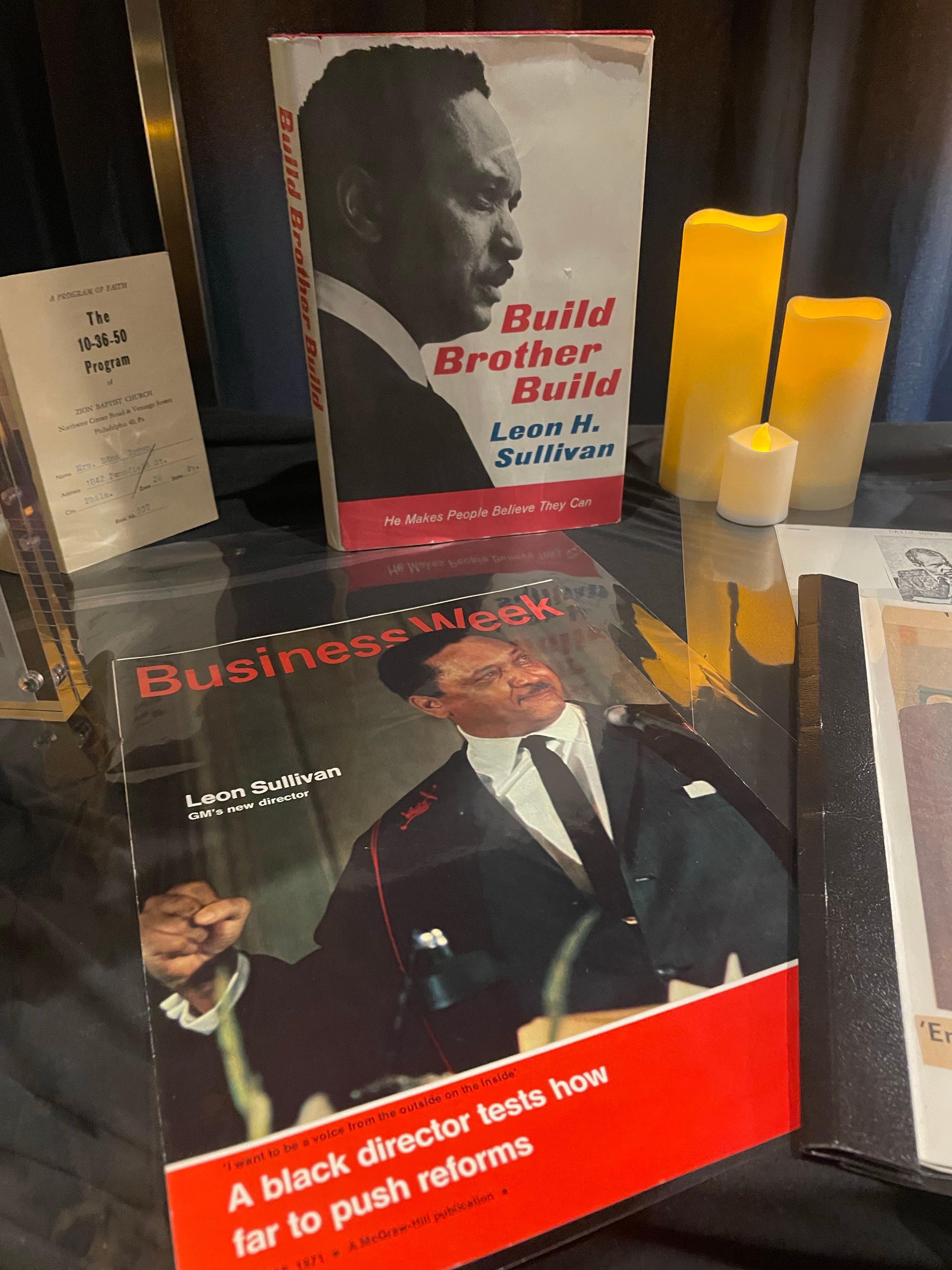
The person that my boss reports to, invited me to join him as a plus one to a 60th anniversary celebration and fundraiser for the Leon H. Sullivan Charitable Trust, who was honoring the person to whom my boss and my boss’s boss must send reports as the regional vice president and representative of our organizations’ respective fiscal sponsorships. This honoree is a woman I have only met virtually in two final interviews that would eventually determine my employment, but also has a wide and positive reputation that precedes her. I looked forward to meeting her. As a plus one, I also looked forward to the moment of quality time I’d be afforded with my boss’s boss, my denominator.
I work in a place and time where we use the word boss ironically. And in cases where the title Chief is embedded in a person’s ascription, it would be inappropriate to use it as a salutation. If I said “yes, boss,” or “yes, chief,” I’d probably be seen as insubordinate—using sarcasm—and been addressed in a private conversation to check in that everything was alright with me. In other words, using these words with feigned sincerity in direct dialogue would make me seem mentally ill.
Aside from the very probable exception that it was so long ago I no longer recall, I have never thought of my professional superiors as having necessarily more power or determination than me. I keep discovering their commitment to entities is as spurious as the person with the lowest paying job. This can be tested very simply with the hypothetical offer of a higher paying job with parallel job responsibilities. This is not to undermine anyone’s commitment to cause or mission, in the case of a nonprofit, but to say that my relationship to power is by definition already relative. Also, and not for nothing…The people at the top tend to have terrible taste in pop culture, and unfortunately this disqualifies all power. Who’s mix tape would you rather have—the one made by the assistant at the front desk or the CEO? What delights and attracts me is raw intelligence, imagination, and intellect.
Sure, of course you do. Everybody does.
Listen. I believe sapiosexuality (am I using this word correctly?) is as problematic as falling unquestionably in line with mild authoritarianism of professional hierarchies. Being the acolyte of a scholar is not necessarily better than to be the shill of a president.
So I am getting mentally prepared for the Leon H. Sullivan Charitable Trust gala, which becomes complicated when just hours before the event is to start, my boss’s boss cancels his attendance. I get a message from him, apologizing profusely, but a terrible family emergency requiring his attention gets in the way. I have had such emergencies prevent me from pithy social engagements, too. I assure him it’s all fine. And I realize I really did think highly of this person, otherwise I would not be sorely disappointed. I also contradict the thesis I just stated that I have no authentic respect for power, because when I get this note, despite my wanting to also bow out, I know I still have to attend the event as a professional obligation.
I wanted to bail because a very dear friend was celebrating his birthday with a house party for which he was cooking all day and he’s an amazing home cook. I’d have rather been there all night than in a hotel ballroom. But the real centerpiece of this gala was not to attend with my boss’s boss. It was to celebrate my boss’s boss’s boss. I had to meet her, the honoree and chair person of the role sponsored and made privileged through our final boss, yet another Charitable Trust.
While getting ready for the gala, my now cancelled date suggested the night would have been well spent if I were there for even five minutes to bend the honoree’s ear. Indeed I was hoping to be in and out of this event with a quickness; was hoping to get to the birthday party before cake was revealed. I agreed with this strategy. Funnily enough, when I told my birthday friend why I was going to be late, he laughed and shared that he was the first person invited as a plus one, and politely declined due to birthday plans. I was either a second or third string player.
I did not know anything about the LHSCT until an hour before leaving the house, when my partner suggested I google it before walking into a foreign environment with a black tie dress code. So let me attempt a description of the organization from memory.
The Leon H. Sullivan Charitable Trust is a 60 year organization built upon the vision of its namesake founder, the founding Black Baptist reverend of Zion Baptist Church and business leader. His vision was to create a public community trust built in arrangements of nonprofit, public, and private sector cooperatives to secure real estate and business development opportunities that would protect Black Philadelphians from economic harm. As a movement organizer, he mobilized a coalition of Black churches in North Philadelphia to raise money to build what is now Progress Plaza, through the 10-36 strategy: constituents would kick in ten dollars a month (a week? I forget), for 36 months. With thousands of contributors and the backing of civic and corporate entities, they built power, instantly. The presence they secured in North Philadelphia still has enduring power.
It’s worth noting how beautifully Black the gala was because by contrast, the person who invited me is a slight (if stately) white man with a bald head, and would have looked like a light bulb in the space. Without him there as a buffer, I was making conversation with total strangers, until I eventually discovered many of my peers were in attendance sitting on the either ends of a ballroom filled with over 400 people. That was the other awkward thing about the evening. I was seated at the table directly in front of the stage and podium. Once the program started, I would inevitably be in the foreground sightline of everyone else in attendance. I don’t think I could have discreetly stepped away “with a quickness” after all.
Turns out I didn’t want to, anyway. The pageant of speakers was incredibly talented, and the emcee was Drop. Dead. Gorgeous. I’ll briefly flash forward to when friends who attended the gala who were also heading to James’ birthday rejoined with me at the birthday party after the gala. When recapping the thing, we all gushed over how we were improbably seduced by her in this church adjacent environment.
The night began with a call to prayer, which did not scare me as a person who grew up in a Methodist church culture that bordered on obsessive for my mother. But knowing the prayer was coming up made me nervous in only the way it can make community activists wring their hands. What if someone finds this problematic? What if an atheist gives grief over this? Of course it didn’t matter in the end. Not only because the LHSCT has built into its founding charter the fact that the movement was led by a Christian leader and built by churches, but because the pastor who led the prayer came to the stage with so much definition and confidence that no one would have dared disobey. The pastor looked like a collegiate football player, which is not to place his age but to describe his credulous form. He stepped up to the podium, looked straight ahead, clasped his hands at his groin, spread his feet, and said:
Let us pray.
I bowed my head and listened to a poetic call to action. Give thanks. Recognize each other. Listen.
Throughout the night, I heard about a dozen testimonies to community, God, and legacy, from business owners, educational leaders, and ecumenical scholars. These speeches varied in profundity and humor, but when the honoree for whom I was in attendance finally came to the stage, the quality of attention in the room changed. She was the only one who elicited a standing ovation as she walked up to the stage.
I’m not sure why I’m feeling so protective of her identity as I write about her in the abstract here, but there is a privacy I want to afford both of us. My distrust of the internet is counterbalanced by the latent effect of having broken bread in fellowship with a community I discovered I also belonged in that night.
The honoree spoke clumsily (by her own admission), about how she got to this point and what mattered most to her—the family that buoyed her into greatness. She culminated with a teary recognition of her husband who has been having grave health issues for the past several years. My respect for her transformed into admiration. Sapiosexual (lol). She really did appear to change into more of a manifestation of Mary J. Blige than Sister Mary.
Her invocation of family reminds me that in one of my interviews with her, she appeared quite late, and the recruiter who staged the interview had let me know that she was with her husband who had to be rushed to a hospital, and they all appreciated my patience with the rapid redesign of our zoom call. At the time, I was offended on her behalf that an interview had to take any kind of precedent at all. Shouldn’t she have been given the grace of time off and to reschedule my call?
I was desperate to share this anecdote and put my physical form to the acquaintance we have now made by proxy in our jobs, but the room was a positive swarm of networking activity the second the program ended. Fortunately I was near her already and was able to walk up without much pushing, but even closer to her were mutual colleagues. A philanthropist from a peer institution I knew from an advisory committee, and the director of a North Philly CDC were already in an early conversation with her. I really wanted to talk to her and get out of there, to finish my job and take my earrings off, to confirm my significance to her and to have her significance demonstrated to me.
I hated how I felt pushing away my professional colleagues to get that face time with her. I like to think I was somewhat graceful, but it wouldn’t have mattered because after giving my effusive postulation of our intimacy, holding her hands as if in prayer, and letting her hold my face with care bordering on maternalism, she said:
“Your hair changed! It’s so good to finally meet. Thank you so much for your support.”
I know she meant it, and that social events like this are not ideal for real conversation. This isn’t to discount any part of the experience, but “thank you for your support” lands hard on me. It’s hard to explain even now, a weekend later, but the ambivalence of the phrase see saws in my mind. I lofted down again from admiration to respect; which is perfectly respectable. I was back in church, where Sunday to Monday, a feeling would change to accommodate circumstances.
Never minding this entire part 1 of my night, the gala ended and I had to immediately shift gears for a birthday party I’d been looking forward to all week. Running to the street and hailing a cab (it was almost 11pm now and I couldn’t afford to lose much more time), I sat in my black tie gala attire tickling myself at the thought of showing up to a house party in full drag. I reflected upon how important the church has been to James, to his life long friends from this city, who were going to be at the party. When I get there, I talk about the gala like a bard. There’s a deep tenderness in everyone’s face when I share how touched I was by the pastor’s call to prayer and the general churchiness of the night. I know the tenderness also represents how complicated this is by the fact that people don’t want to go to church anymore. Our houses of worship came to our homes of prayerful families, who have matured to now wishful adults who live in spiritual apartments. The dilution of our trust in God reveals a trust in each other, and a call to prayer, it turns out, is much more meaningful than an acknowledgement of support.